

 By
By If you have been wondering why certain websites consistently dominate Google’s top positions while others with technically solid content keep getting buried, the answer almost always comes back to one thing: E-E-A-T.
Over the past few years, Google has quietly but decisively shifted its ranking philosophy. The era of gaming rankings with keyword density, backlink volume, and meta-tag tricks is over. What Google rewards now is something far more difficult to fake — genuine credibility. And E-E-A-T is the framework that defines it.
This guide covers everything you need to know about E-E-A-T SEO strategies in 2026: what each component means in practice, how Google evaluates it, and the specific actions you can take today to build it across your site.
What Is E-E-A-T? A Clear Definition
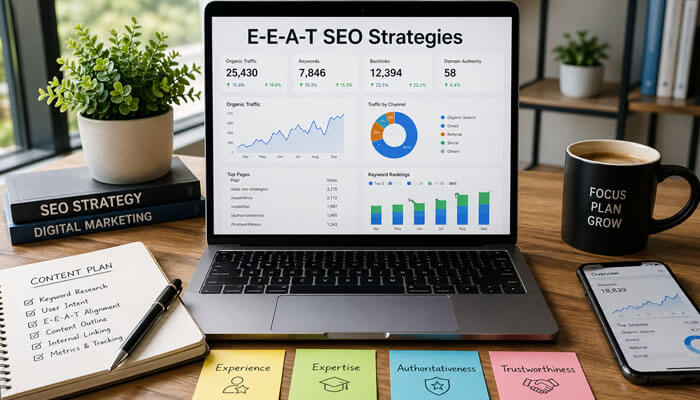
E-E-A-T stands for Experience, Expertise, Authoritativeness, and Trustworthiness. It originated as a framework inside Google’s Search Quality Rater Guidelines — a document used by thousands of human quality evaluators worldwide to assess the credibility and helpfulness of web content.
Google first introduced the concept as E-A-T (without the first “E”). In late 2022, it added the “Experience” component, explicitly recognizing that firsthand knowledge carries a different and complementary value to formal expertise. Since then, the framework has grown increasingly central to how Google evaluates content quality.
A few important clarifications before going further:
- E-E-A-T is not a direct ranking factor. There is no single “E-E-A-T score” that Google computes and assigns to pages. Instead, it is a qualitative framework that shapes and informs how Google’s algorithms identify high-quality content.
- E-E-A-T standards vary by industry. The bar is significantly higher for topics that can affect someone’s health, finances, safety, or legal standing — collectively referred to as YMYL (Your Money or Your Life) content.
- All content types are evaluated. Whether you run a B2B SaaS blog, an e-commerce site, a personal finance platform, or a local business website, E-E-A-T principles apply.
Why E-E-A-T Matters More Than Ever in 2026
The web is flooded with content. Generative AI tools have made it trivially easy to produce vast quantities of plausible-sounding articles, product descriptions, and how-to guides. Google’s challenge — and its solution — is to separate content that demonstrates genuine human knowledge from content that merely mimics it.
Pages with strong E-E-A-T signals have a significantly higher probability of reaching Google’s top positions compared to those with weak signals. Google’s February and March 2026 core updates further amplified these signals, particularly strengthening the weight of the Experience component. Sites with structured author pages, verifiable credentials, and firsthand insight saw measurable ranking improvements, while unattributed content and generic overviews lost significant ground.
Perhaps more critically, E-E-A-T now determines whether your content is eligible to be cited in AI Overviews and other AI-driven search experiences. A page without verifiable author authority is disadvantaged not just in traditional rankings, but in the AI retrieval layer that increasingly sits above organic results.
The Four Pillars of E-E-A-T: What They Mean in Practice
1. Experience: Show That You Have Actually Done the Work
Experience is the newest and arguably most important addition to the framework. It asks a specific question: does the content creator have firsthand, real-world engagement with this topic?
This is different from expertise. A cardiologist has expertise in heart health. A patient who has undergone bypass surgery and documents their recovery has experience. Google values both, but it has become especially focused on distinguishing authentic human insight from polished-but-hollow summaries.
How to demonstrate Experience:
- Document processes you have personally undertaken. Share specifics — timelines, outcomes, what worked and what did not. Saying “after testing 14 email subject line variations over six months, we found that questions outperformed statements by 23%” is more credible than saying “questions work well in subject lines.”
- Acknowledge failures. Sharing what did not work is one of the clearest signals of genuine experience. A content factory optimizing for volume does not include failures. Real practitioners do.
- Use specific, verifiable context. Mention timelines, tools, data, and circumstances. “When we migrated a 50,000-page e-commerce site to a new CMS in 2024” provides the kind of grounded detail that signals authenticity.
- Include case studies and before/after data. Numbers from real projects — bounce rate changes, traffic growth, conversion improvements — are far more credible than general claims.
For product reviews, personal finance guides, travel recommendations, and DIY content, firsthand experience carries the most weight. Google has directly stated that it looks for content written by people who have “personally used the product” or “visited the place.”
2. Expertise: Demonstrate Depth of Knowledge
Expertise refers to the depth and accuracy of the knowledge presented in your content. For YMYL topics, this often requires formal credentials. For most other topics, demonstrated practical expertise through the quality of your content is sufficient.
Formal expertise matters most in regulated domains:
- Medical content should be written or reviewed by licensed healthcare professionals
- Financial advice should come from certified financial planners or economists
- Legal guidance should be authored or reviewed by qualified legal practitioners
Demonstrated expertise matters everywhere:
- Content depth that goes well beyond surface-level coverage
- Accurate use of technical terminology
- Proper citations to credible external sources
- An ability to explain nuanced distinctions that a non-practitioner would miss
A self-taught developer with a detailed portfolio of open-source contributions can demonstrate expertise just as convincingly as someone with a computer science degree. Google evaluates expertise through the content itself — not exclusively through credentials.
One of the most effective ways to build topic-level expertise signals is through content clustering. A site with 50 well-interlinked articles about a single subject demonstrates far more expertise than one with five articles about SEO, five about cooking, and five about travel. Topical depth tells Google you are not just covering a subject — you own it.
3. Authoritativeness: Build Recognition Outside Your Own Site
Authoritativeness is about recognition. It is not enough to have experience and expertise — other credible sources need to recognize and validate your authority. This is why authoritativeness is heavily tied to off-page signals.
How authority is evaluated:
- Backlinks from reputable, topically relevant sources. A link from a major industry publication, a university, a government site, or a recognized media outlet carries far more weight than a high-volume of generic directory links. In 2026, relevance and editorial integrity have overtaken raw domain authority as the primary link quality signal.
- Brand mentions (with and without links). Google tracks unlinked mentions of your brand across authoritative platforms as a form of endorsement.
- Industry recognition. Speaking at respected conferences, winning awards, earning certifications, and being quoted as a source all contribute to authoritativeness.
- Guest contributions. Publishing expert articles on established industry sites builds author-level authority. Platforms like Search Engine Journal, Moz, or major vertical publications in your niche are appropriate targets.
- Consistent author presence. The same author photo, consistent bio, and linked social profiles across all platforms help Google establish you as a recognizable entity in its knowledge graph.
A particularly effective strategy for building authority is original research and proprietary data. When your site publishes unique statistics, survey results, or original methodologies, other publishers cite you as a source. That creates editorial links you cannot buy — and it positions you as a primary source rather than a derivative one.
4. Trustworthiness: The Foundation Everything Else Depends On
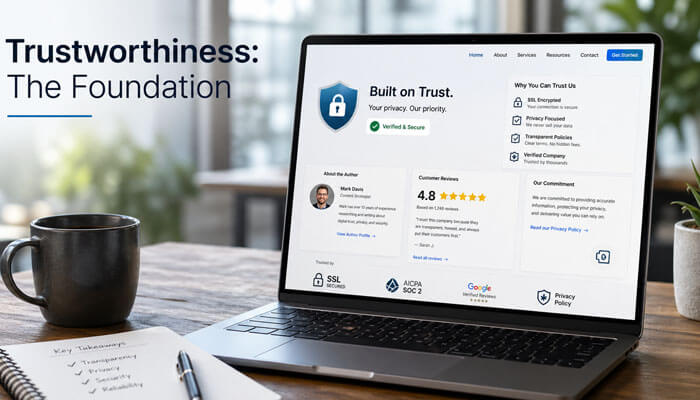
Of all four components, trustworthiness is considered the most foundational. You can have genuine experience, deep expertise, and strong external recognition — but if users and search engines cannot trust your content or your site, none of it matters.
Trustworthiness operates on multiple levels: technical, editorial, and transactional.
Technical trust signals:
- HTTPS is non-negotiable. Any site still on HTTP in 2026 is actively signaling untrustworthiness.
- Core Web Vitals — fast loading, visual stability, responsive interactivity — reduce friction and reinforce credibility.
- Mobile responsiveness across all devices.
- Clean site architecture that is easy to navigate.
Editorial trust signals:
- Accurate, verifiable factual claims with citations to reputable external sources
- Clear disclosure of editorial processes and standards
- Regular content updates — stale content, particularly in health and finance, actively erodes trust
- No clickbait, no misleading headlines, no content that over-promises and under-delivers
Transactional and transparency signals:
- Prominent “About” pages that explain who is behind the site and why they are qualified
- Clear contact information
- Privacy policy, terms of service, and editorial guidelines that are accessible and readable
- For e-commerce: visible return policies, secure checkout, and customer reviews
The YMYL Dimension: When E-E-A-T Requirements Intensify
YMYL stands for Your Money or Your Life. It refers to content where inaccuracies or low quality can cause genuine real-world harm — financial loss, medical harm, legal jeopardy, or civic misinformation.
Google holds YMYL content to substantially higher E-E-A-T standards. The September 2025 update to the Search Quality Rater Guidelines expanded the YMYL category to now explicitly include:
- Health and safety content (symptoms, medications, mental health, nutrition, emergency guidance)
- Financial security content (investments, mortgages, retirement planning, tax guidance)
- Government, civics, and society (elections, voting information, public institutions — newly expanded in 2025)
- Legal guidance, content about groups of people, and anything where inaccuracy could cause societal harm
If your site operates in any of these verticals, anonymous authorship is not just a missed opportunity — it is a structural disqualification. Google’s quality raters cannot evaluate the expertise of a non-existent author. Every YMYL piece must carry a named, credentialed author with a linked bio page that includes their qualifications, relevant experience, and where applicable, their professional certifications or registrations.
Practical E-E-A-T SEO Strategies You Can Implement Now
Build and Optimize Author Pages
After the March 2026 core update, author pages are no longer optional for sites competing in any moderately contested niche. Every author page should include:
- Full name and professional headshot
- Specific credentials, certifications, and qualifications relevant to the content they produce
- Links to LinkedIn, industry associations, or published external work
- A clear description of their domain-specific expertise
- Examples of their published work, ideally with links
Author pages are not just for users — they are for Google’s entity recognition systems. Google maps relationships between entities: authors, brands, and topics. When an author is consistently associated with specific subject matter across multiple authoritative platforms, it strengthens the trust signals attached to every piece of content they publish.
Implement Schema Markup Strategically
Structured data does not directly improve rankings, but it helps search engines understand and correctly classify your content — which has indirect E-E-A-T implications. Useful schema types include:
- Article schema with
author,datePublished, anddateModifiedfields populated - Person schema on author bio pages, connecting individuals to their credentials and published works
- Organization schema with accurate
name,url,logo, andcontactPointdata - FAQPage and HowTo schema where appropriate — these formats also improve citation odds in AI Overviews
- Review schema for product content, with genuine review data rather than manufactured ratings
Build Topical Authority Through Content Clusters
Topical authority is one of the clearest ways to simultaneously improve all four E-E-A-T signals. The approach:
- Choose a narrow niche and commit to covering it comprehensively
- Build a pillar content piece — a comprehensive, definitive guide on the core topic
- Create supporting cluster articles that cover related subtopics in depth, each linking back to the pillar
- Interlink strategically to show the relationships between content and reinforce topical depth
- Keep content current — update articles with new data, revised recommendations, and “last reviewed” dates
A site with 40 well-interlinked, deeply researched articles about a specific subject convinces Google it is a genuine authority resource. That authority benefits every page on the site.
Earn Editorial Backlinks Through Original Research and Digital PR

Generic link-building tactics — directory submissions, private blog networks, mass guest posting on irrelevant sites — are not only ineffective for E-E-A-T; they can actively damage trust signals. The strategies that work in 2026 are:
- Publish original data. Survey your customers, analyze industry trends, or compile publicly available data into a unique study. Other publishers cite unique statistics because they need sources — and those citations become high-quality editorial links.
- Use journalist inquiry platforms (such as HARO or Connectively) to position your subject matter experts as quoted sources in industry media.
- Pursue strategic guest contributions on respected publications in your niche. A single well-placed article on a major industry site is worth more than 50 placements on low-relevance blogs.
- Reclaim unlinked brand mentions. Track where authoritative sources reference your brand without a link and reach out to convert those mentions into backlinks.
Update Content Regularly — and Document the Updates
Google rewards content freshness, but raw date changes without substance behind them provide no value. Meaningful content updates include:
- Replacing outdated statistics with current data and citing the updated source
- Revising recommendations to reflect current best practices
- Adding new sections that address questions that have emerged since original publication
- Updating the “last reviewed” date only after making substantive changes
For YMYL content, more frequent review cycles — at minimum every six months — are expected. A medical article citing 2022 research in 2026 actively undermines trust.
Prioritize Transparency Across Your Site
Trust is built through visibility. The more clearly you communicate who you are, why you are qualified, and how your site works, the more confident both users and Google’s systems can be.
Practical transparency actions:
- Write a detailed, honest “About” page — not marketing copy, but genuine information about the people and mission behind the site
- Make contact information easy to find (not just a form, but a real email or phone number where appropriate)
- Publish your editorial guidelines so users understand your standards for accuracy and sourcing
- If you use AI tools in content production, acknowledge it and explain your human review process
- For e-commerce and financial sites, ensure your disclosures, disclaimers, and policies are current and visible
How to Audit Your Site’s E-E-A-T Signals
Since there is no single E-E-A-T metric to track, auditing requires evaluating multiple layers:
Content audit (every 6–12 months):
- Are all high-traffic pages attributed to a named author with a linked bio?
- Does each piece cite credible external sources?
- Is the information current and accurate?
- Does the content demonstrate genuine experience and not just surface-level coverage?
Technical trust audit:
- Is HTTPS fully implemented across the entire site?
- Are Core Web Vitals within acceptable ranges?
- Is the site mobile-responsive and fast across device types?
Author and entity audit:
- Do author pages exist for all active contributors?
- Is schema markup implemented on author pages and article pages?
- Are authors consistently attributed across all publications — both on-site and off?
Off-page authority audit:
- What is the quality and topical relevance of your backlink profile?
- Are there brand mentions that lack links?
- Has your brand been covered, quoted, or cited by recognized industry publications?
E-E-A-T and AI Content: The Clear Line
This deserves direct address because so much confusion exists around it.
Google has not banned AI-generated content. What it has done — explicitly and repeatedly — is raise the standard for what qualifies as valuable content regardless of how it was produced. The question Google asks is not “was this written by a human?” but “does this content demonstrate genuine experience, expertise, authoritativeness, and trustworthiness?”
A piece produced with AI assistance but thoroughly reviewed by a subject matter expert, enriched with original firsthand insights, attributed to a named author who takes accountability for its accuracy, and genuinely aligned with user intent can satisfy E-E-A-T standards.
A piece produced by AI, lightly edited, published anonymously, and designed primarily to capture search traffic almost certainly will not — and Google’s systems have become substantially better at identifying it. The January 2025 update explicitly assigned the lowest quality rating to content that is “AI-generated in a low-effort way.”
The practical takeaway: AI is a legitimate tool for research, outlining, and drafting. It is not a replacement for the human experience, editorial judgment, and subject matter knowledge that E-E-A-T actually measures.
The Long Game: Why E-E-A-T Investment Compounds Over Time
Unlike technical SEO fixes, which can produce immediate results, E-E-A-T improvements are a long-term investment. Most sites see meaningful impact within three to six months, but building external authority through earned media and relevant backlinks often takes twelve months or more to register fully.
This is precisely what makes it a durable competitive advantage. The trust and authority you build over time become increasingly difficult for competitors to replicate. A well-established author with years of recognized contributions in a specific niche, a site with hundreds of deeply researched and carefully maintained articles, a brand that journalists and industry peers regularly cite as a source — these are not things that can be quickly reverse-engineered.
Sites that survive Google’s algorithm updates, year after year, are overwhelmingly the ones that invested in becoming genuinely worthy of ranking well. E-E-A-T is not a tactic — it is the standard to which Google holds content. Build your site accordingly, and the rankings follow.
Final Thoughts
E-E-A-T SEO is ultimately about one thing: being the best answer to the question someone is asking — not just the most optimized page.
When you invest in building real experience, demonstrating genuine expertise, earning legitimate recognition from your peers, and maintaining the kind of transparency that creates user trust, you stop chasing Google’s algorithm and start aligning with its fundamental mission. That alignment is what produces sustained organic visibility.
The strategies covered in this guide — detailed author pages, topical content clusters, original research, editorial backlinks, technical trust signals, and transparent site operations — are not quick wins. They are the building blocks of a site that Google trusts, users rely on, and competitors find very difficult to displace.
That is what E-E-A-T is designed to reward. And in 2026, it is more capable of doing exactly that than at any point in search engine history.