


 By
By Introduction
In today’s fast-paced global economy, business innovation is no longer optional—it’s essential. Companies that innovate grow faster, adapt to market changes, and maintain competitive advantage. But what exactly is business innovation, how does it work, and why does it matter more now than ever? This deep research article explores foundational concepts, practical strategies, real‑world examples, and steps to embed innovation into your organization’s DNA.
What Is Business Innovation?
Business innovation refers to the process of creating and implementing new ideas, products, services, processes, or business models that bring added value to the organization and its stakeholders. It isn’t limited to tech startups—legacy companies, service industries, and even non-profits can innovate meaningfully.
At its core, business innovation:
- Solves real problems
- Improves efficiency
- Enhances customer experience
- Drives sustainable growth
Innovation often transforms the entire industry, unlike small improvements.
Types of Business Innovation
Understanding different innovation types helps businesses select the right approach for growth:
1. Product Innovation
Developing new products or enhancing existing ones.
- Example: Electric vehicles transforming the automotive industry.
2. Process Innovation
Improving internal workflows to boost efficiency.
- Example: Automation of manufacturing processes.
3. Business Model Innovation
Reinventing how a company creates, delivers, and captures value.
- Example: Subscription models replacing one‑time sales.
4. Service Innovation
Redefining customer experiences through new service delivery.
- Example: On‑demand services like Uber and Airbnb.
5. Organizational Innovation
Changes in leadership, culture, and structure.
- Example: Flat hierarchies to encourage collaboration.
Why Business Innovation Matters
Innovation is a key driver of long-term success. Here’s why:
Adapting to Market Change
Markets evolve rapidly; innovation enables companies to stay relevant.
Competitive Advantage
Innovators lead industries and outperform competitors in growth and profitability.
Customer Expectations
Modern customers expect faster, better, and personalized experiences.
Operational Efficiency
Innovative improvements often save time and reduce costs.
Talent Attraction
Innovative workplaces attract skilled talent who seek dynamic career environments.
Principles of Effective Business Innovation
Innovative companies follow structured principles that guide sustainable progress:
1. Customer‑First Approach
Understanding customer needs leads to meaningful innovation.
2. Risk‑Taking Culture
Innovation requires experimentation—and sometimes failure.
3. Cross-Functional Collaboration
Facilitating communication between departments accelerates ideation and implementation.
4. Continuous Learning
Data and feedback fuel iterative improvements.
5. Leadership Commitment
Innovation thrives when leaders champion strategic change.
The Business Innovation Process: Step‑by‑Step
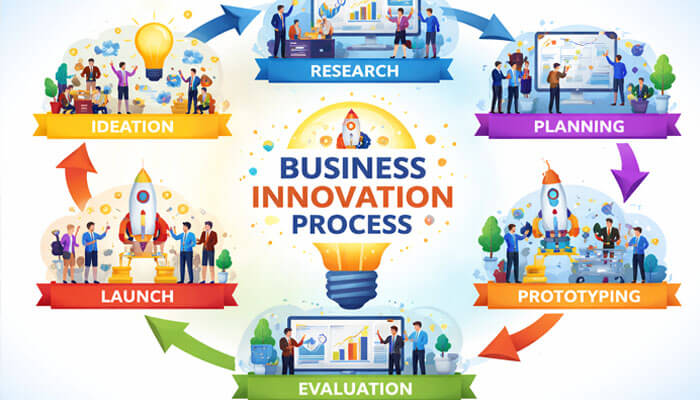
1. Identify Opportunities
Use data, market research, and customer insights to discover unmet needs.
2. Ideation
Brainstorm ideas openly and encourage unconventional thinking.
3. Evaluate & Prioritize
Assess ideas based on feasibility, impact, and alignment with business goals.
4. Prototype & Test
Build minimal viable versions and test with real users.
5. Implement
Deploy the solution and train teams for effective adoption.
6. Measure & Iterate
Continuously evaluate performance and refine based on results.
Tools & Technologies Fueling Innovation
In the digital era, certain tools accelerate innovation:
- Artificial Intelligence (AI)—Predictive analytics, automation
- Cloud Computing—Scalable infrastructure for experimentation
- Data Analytics—Customer insights and performance metrics
- Collaboration Platforms – Remote teamwork and idea sharing
- Design Thinking Frameworks—Human-centric problem solving
Real‑World Examples of Business Innovation
Apple Inc.
Transformed consumer electronics with intuitive design and ecosystem strategies.
Netflix
Pivoted from DVD rentals to digital streaming—disrupting entertainment.
Tesla
Blended electric vehicles with software and renewable energy solutions.
Toyota
Introduced Lean manufacturing that revolutionized production efficiency.
How to Build an Innovation‑Ready Organization
Here’s a roadmap for embedding innovation into your company:
Develop an Innovation Strategy
Define goals, success metrics, and investment priorities.
Empower Employees
Train staff, reward ideas, and create open communication channels.
Invest in R&D
Allocate dedicated resources for experimentation and discovery.
Measure Progress
Use KPIs like time to market, customer satisfaction, and revenue growth.
Partner & Collaborate
Work with startups, universities, and industry networks.
Conclusion
Business innovation is a strategic imperative for sustainable growth. It enables companies to solve complex problems, unlock new opportunities, and remain competitive in an ever-evolving market. By embracing innovation as a core business function—not a one-off project—organizations can build resilience, agility, and future-ready advantage.