

 By
By In a world where competition is fierce and financial stability is key to sustainability, business budgeting is no longer just an administrative task; it is a strategic necessity. It serves as the backbone of financial health for businesses of all sizes. Whether you are launching a startup, running a small business, or managing a multinational corporation, understanding the intricacies of budgeting will help you optimize operations, control costs, and achieve your business objectives.
In this comprehensive guide, we delve deep into business budgeting, offering insights on how to create a robust budget, common pitfalls to avoid, and the best practices that ensure financial success.
What Is Business Budgeting?
At its core, business budgeting is the process of creating a financial plan that outlines expected income, expenses, and profits over a specific period, typically a fiscal year. It is a roadmap that helps businesses allocate resources, forecast financial performance, and keep expenditures in check.
The Role of a Budget in Business Strategy:
A business budget acts as a decision‑making tool, guiding your financial choices. It ensures that resources are directed toward your most critical goals, such as:
- Product development and innovation
- Sales and marketing efforts
- Expansion into new markets
- Employee compensation and benefits
Moreover, a well‑structured budget enables businesses to measure their financial health against projections, making it easier to identify and address financial issues before they escalate.
The Importance of Business Budgeting
A solid business budget is not just a tool for tracking expenses; it offers numerous strategic benefits:
1. Supports Decision‑Making
Business budgeting gives you data to make informed decisions about capital investments, marketing spends, and hiring plans. With clear financial insights, leaders can confidently decide where to allocate resources for the highest return on investment.
2. Prevents Over‑Spending and Debt Accumulation
Without a clear budget, businesses may overspend on non‑essential areas, accumulating debt and risking cash flow problems. A well‑designed budget prevents this by keeping spending within manageable limits.
3. Helps Achieve Financial Goals
Business budgeting is instrumental in setting and achieving financial goals, whether you aim to increase profits, expand operations, or improve cash flow.
4. Enables Risk Management
By outlining potential expenses and income, a business budget highlights potential financial risks. This foresight allows you to develop contingency plans to mitigate risks like fluctuating costs, unexpected expenses, or market downturns.
Types of Business Budgets: Choosing the Right One for Your Business
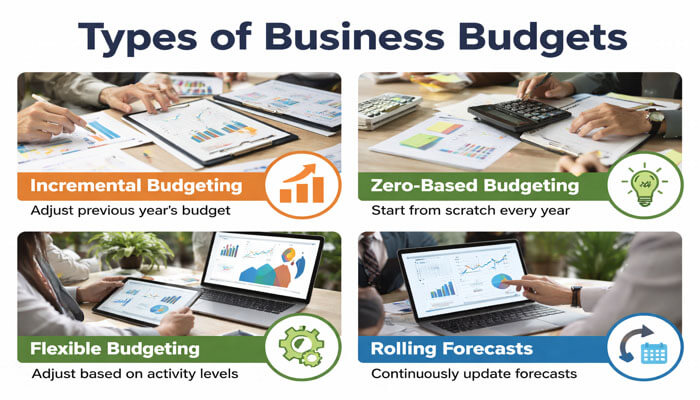
Different businesses have varying needs, and selecting the right type of budget is crucial. Here’s a breakdown of the most common types of business budgets and when to use them:
1. Incremental Budgeting
This traditional approach takes last year’s budget and adjusts it slightly, either up or down, to account for growth or reduced revenue. It’s the simplest type, ideal for stable, mature businesses.
- When to use: Established companies with predictable income and costs.
- Example: A law firm adjusting its previous year’s budget based on modest client growth.
2. Zero‑Based Budgeting (ZBB)
Every budget line item starts from zero, and each expense must be justified. ZBB is a thorough method that helps companies eliminate unnecessary expenditures.
- When to use: Companies looking to cut costs and operate more efficiently.
- Example: A manufacturing company seeking to streamline operations and reduce overhead costs.
3. Flexible Budgeting
Flexible budgets are adjusted in real time based on changes in revenue or other key variables. This is particularly useful for businesses with fluctuating sales or seasonal operations.
- When to use: Retailers and service providers with highly variable income.
- Example: An e‑commerce store adjusting its marketing spend based on seasonal traffic spikes.
4. Rolling Forecasts
Rather than planning for the entire year at once, rolling forecasts are updated continuously, typically every quarter. This allows businesses to adapt to changing conditions more quickly.
- When to use: Tech companies or startups with rapidly changing conditions.
- Example: A tech startup adjusting its research and development budget based on new product testing results.
Steps to Create an Effective Business Budget
Creating a successful business budget involves more than just plugging numbers into a template. Here’s a step‑by‑step guide to developing a budget that aligns with your goals:
Step 1: Set Clear Business Objectives
Start by defining the key business objectives for the period the budget will cover. These could range from increasing sales, improving customer retention, reducing operational costs, or expanding into new markets.
Example: A restaurant may set an objective to increase its take‑out orders by 10% in the next quarter, which would guide budgeting decisions for marketing and staff scheduling.
Step 2: Gather Historical Data
The most reliable budget forecasts come from historical data. Review your financial performance over the last few years to understand seasonal trends, common expenses, and income streams.
Example: A construction company can analyze project costs over the last few years to forecast future project expenses more accurately.
Step 3: Forecast Sales and Revenue
Accurate revenue forecasting is the foundation of any business budget. Base your forecasts on historical data, market conditions, and industry trends.
Tip: Avoid overly optimistic projections. If necessary, build multiple scenarios (best case, worst case, most likely).
Step 4: Estimate Costs and Expenses
Next, categorize expenses into fixed (salaries, rent, utilities) and variable (marketing campaigns, raw materials). Don’t forget to include one‑off costs like equipment purchases or software upgrades.
Example: A software company may predict rising cloud hosting fees due to a product launch.
Step 5: Calculate Profit Margins
After you’ve estimated both revenues and expenses, calculate your expected profit margins. This will help you understand if you’re on track to meet your financial goals.
Step 6: Review, Adjust, and Monitor
Once the initial budget is created, review it with key stakeholders in the company. Make necessary adjustments based on feedback and changes in business conditions. Then, implement regular tracking to compare actual performance against the budget and update it as needed.
Common Mistakes in Business Budgeting (and How to Avoid Them)
Even experienced business owners can make mistakes when budgeting. Here are some common pitfalls and tips to avoid them:
1. Overlooking Cash Flow
A common mistake is focusing only on profitability while neglecting cash flow. Cash flow is vital to your ability to meet short‑term obligations, such as paying employees or suppliers.
Solution: Ensure your budget includes a detailed monthly cash flow forecast.
2. Failing to Adjust for Market Changes
Business environments are dynamic, and a static budget that doesn’t account for market changes can quickly become obsolete.
Solution: Regularly revisit and update your budget, especially during significant industry shifts.
3. Underestimating Costs
Underestimating fixed or unexpected costs (like repairs or legal fees) can lead to budget overruns.
Solution: Be conservative in cost estimations and always include a contingency fund.
4. Not Getting Team Input
A top‑down budgeting approach that doesn’t involve department heads can lead to inaccurate estimates and missed opportunities for cost savings.
Solution: Engage with various teams across your business for a collaborative approach.
Conclusion: Mastering Business Budgeting for Success
Business budgeting is more than just a financial plan — it’s a strategic tool that empowers you to make informed decisions, track performance, and achieve your business goals. Whether you are managing day‑to‑day operations or planning for long‑term growth, a solid budget is essential for navigating the complexities of modern business. With the right tools, mindset, and approach, business budgeting can become your business’s most reliable ally in driving profitability, efficiency, and success.