

 By
By Search is no longer just about ranking on Google. Today, when someone asks ChatGPT, Perplexity, or Google’s AI Overviews a question, they get a direct answer — and that answer cites specific sources.
How AI Engines Decide What Content to Cite
Generative Engine Optimization (GEO) is the practice of making sure your content is one of those sources. If you’re a marketer or developer who wants to stay visible in the age of AI search, this guide covers everything you need to know.
1. What Is Generative Engine Optimization?
Generative Engine Optimization (GEO) is the practice of optimizing your content, website structure, and brand presence so that AI-powered answer engines — such as ChatGPT, Google AI Overviews, Perplexity, and Microsoft Copilot — cite, reference, and recommend your content in their generated responses.
Where traditional SEO earns you a position on a search results page, GEO earns you a place inside the answer itself.
Think of the difference this way: SEO puts your blue link on the shelf. GEO gets your brand spoken out loud.
The term was formally introduced in a Princeton, Georgia Tech, and IIT Delhi research paper in 2023, and it has since evolved into one of the fastest-growing disciplines in digital marketing. In 2024, the GEO market was valued at $886 million. By 2031, analysts project it will reach $7.3 billion — a compound annual growth rate of 34%.
This is not a niche experiment. It is the new frontier of search visibility.
2. Why GEO Matters Right Now
The numbers behind GEO’s rise are hard to ignore.
The search landscape is shifting beneath our feet. AI-referred website sessions grew 527% year-over-year in the first five months of 2025. ChatGPT reached 800 million weekly active users by October 2025 — doubling in just eight months. Google AI Overviews now appear in more than half of all search queries and span over 200 countries in 40-plus languages. Perplexity, once a niche tool, crossed 45 million active users in the second half of 2025.
Traditional organic traffic is declining on AI-present queries. Organic click-through rates dropped 61% between June 2024 and September 2025 for queries where an AI Overview appeared. When an AI summary is shown, users are roughly half as likely to click any link at all. Zero-click rates reach 83% when AI Overviews are present, and as high as 93% in Google’s full AI Mode. E-commerce sites have reported a 22% drop in search traffic directly tied to AI-generated suggestions replacing traditional search clicks.
But the traffic that does arrive from AI is worth more. Visitors referred by AI platforms spend 68% more time on-site than organic visitors. They convert at rates 23 times higher than standard organic search traffic. B2B SaaS companies specifically report 6x to 27x higher conversion rates from AI-referred visitors. The Washington Post found that visitors arriving from AI platforms converted to subscriptions at four to five times the rate of traditional search visitors.
The implication is clear: volume is shifting toward zero-click, but the clicks that remain are high-intent and high-value. GEO is the discipline that captures them.
3. GEO vs. Traditional SEO: Key Differences
GEO and SEO share the same foundational goal — getting your content in front of people who need it — but they operate on different logic entirely.
SEO is built around the page. It asks: how do I get this URL to rank for this keyword? It prioritizes backlinks, keyword density, meta tags, page speed, and technical health. The user must choose to click your result.
GEO is built around the fact. It asks: how do I get this piece of information cited in an AI-generated answer? It prioritizes semantic clarity, entity recognition, content authority, and structured data. The user may never visit your website at all — your brand enters the conversation through the AI’s voice.
Here are the sharpest distinctions:
| Dimension | Traditional SEO | Generative Engine Optimization |
|---|---|---|
| Goal | Rank on SERPs | Be cited in AI-generated answers |
| Optimization unit | The page | The fact or paragraph |
| Key signals | Backlinks, keywords, page speed | Entity clarity, semantic structure, authority |
| User action required | Must click the link | May receive answer without visiting |
| Content format | Long-form, keyword-rich | Semantically chunked, citable |
| Measurement | Rankings, organic traffic, CTR | Citation rate, AI mention frequency |
| Competition | Google SERP positions 1–10 | Inclusion in AI-synthesized response |
One crucial point: GEO does not replace SEO. As of September 2025, Google still sends 345 times more traffic than all AI platforms combined. Traditional search drives 48.5% of internet traffic; AI platforms account for 0.1–0.15% — though that share is growing fast. The strongest strategies combine both. High Google rankings increase your credibility as an AI source, and strong GEO signals reinforce your topical authority in search.
4. How AI Engines Select and Cite Content
To optimize for GEO, you need to understand how large language models actually choose which sources to cite. This is not magic — it follows identifiable patterns.
Entity Recognition and Verification
Before an AI cites your content, it needs to know who you are. AI systems use entity recognition to identify and verify the people, organizations, and concepts behind a piece of content. If your website clearly defines your brand as an organization with a known domain of expertise, AI systems can confidently attribute claims to you. Vague, unbranded content gets passed over.
Semantic Chunking and Extractability
AI engines do not read your article the way a human does. They look for extractable units — standalone sentences or paragraphs that can answer a specific question without surrounding context. A 3,000-word guide might yield only one 60-word paragraph as a citation. That paragraph needs to be complete, accurate, and self-contained.
This is why GEO optimizes at the fact level. Every statistic, definition, and core claim should be written so it makes sense in isolation.
E-E-A-T Signals
Google’s framework of Experience, Expertise, Authoritativeness, and Trustworthiness shapes AI citation decisions just as it shapes traditional rankings. AI systems favor content from demonstrably credible sources — identified authors with credentials, institutional affiliations, original research, cited data, and consistent publishing history.
Content Freshness
Some AI models weight content recency heavily. Regularly updated content, dated statistics, and clear publication timestamps all signal that information is current and reliable.
Training Data vs. Retrieval Augmentation
It is worth understanding the distinction between two modes of AI citation. Some AI answers draw on patterns from training data — information baked into the model before deployment. Others use retrieval-augmented generation (RAG), where the model actively searches the web at the time of the query and cites live sources. Google AI Overviews and Perplexity are primarily retrieval-based. ChatGPT’s web search mode is also retrieval-based. Optimizing for retrieval-based systems requires your content to be crawlable, accessible, and indexed.
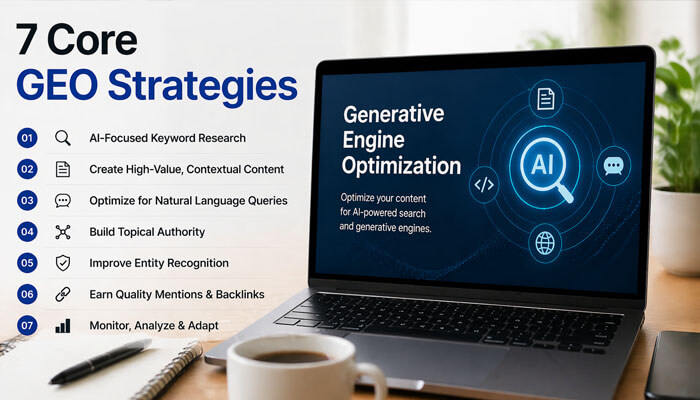
5. The 7 Core GEO Strategies
Strategy 1: Write for Semantic Clarity, Not Just Keywords
AI engines interpret intent and context, not exact keyword matches. Instead of stuffing a target phrase, define your topic with precision. Use clear subject-verb-object sentence structures. Avoid ambiguity. Write as if you are explaining something to a sharp reader who will only see one paragraph of your article.
Practically: open each major section with a direct, definitional sentence. “Generative Engine Optimization is the practice of…” is far more citable than a vague introductory clause.
Strategy 2: Build Genuine Topical Authority
AI systems favor sources that demonstrate deep, consistent expertise in a specific domain. A single article rarely earns citations. A body of interconnected, high-quality content on a topic — articles, case studies, glossaries, data reports — signals that your site is an authority worth quoting.
Publish comprehensive guides, original research, and expert commentary. Build a content cluster around your core subject area. Update content regularly to reflect current data and thinking.
Strategy 3: Optimize for Conversational and Long-Tail Queries
AI search is conversational by nature. Users ask full questions, not keyword fragments. Your content should anticipate the questions your audience is actually asking — not just “GEO strategies” but “how do I get my content cited in ChatGPT answers” or “what is the difference between GEO and SEO.”
Tools like Google’s “People Also Ask,” AnswerThePublic, and your own site search logs are good starting points for question discovery. Structured FAQ sections directly address these conversational queries.
Strategy 4: Cite Data and Name Your Sources
AI systems give more weight to content that demonstrates evidentiary rigor. Include current statistics with named sources, reference original research, and link to authoritative external material. This signals that your content is fact-based and verifiable — exactly the kind of information an AI should pass along to a user.
Do not cite data without attribution. Do not use outdated statistics. The specificity and traceability of your claims directly affects how trustworthy AI systems consider your content.
Strategy 5: Establish Author and Brand Entity Clarity
Create a clear, machine-readable identity for your brand and your authors. This means:
- A well-structured About page that describes your organization’s mission and expertise
- Author bio pages with credentials, affiliations, and areas of knowledge
- Consistent brand name usage across your site, social profiles, and external mentions
- A Wikipedia presence or equivalent authoritative third-party profile (if your brand is sufficiently notable)
When AI systems can verify who you are, they cite you more confidently.
Strategy 6: Earn Third-Party Mentions and Brand Signals
AI systems are influenced by what the broader web says about you, not just what you say about yourself. Brand mentions in reputable publications, citations in industry reports, forum discussions on Reddit or LinkedIn, podcast appearances, and expert quotes all contribute to your AI citation profile.
Importantly, user-generated content platforms carry more weight in AI-generated answers than many marketing teams assume. A brand that is genuinely discussed in professional communities has a different AI citation footprint than one that only publishes its own content.
Strategy 7: Make Your Content Technically Accessible
AI crawlers need to reach and parse your content. Ensure your most important pages are not gated behind logins, paywalls, or JavaScript rendering that blocks crawlers. Keep robots.txt policies deliberate — some brands have inadvertently blocked AI crawlers while trying to protect their content. Use a clean, crawlable site structure. Submit your sitemap. Load times and Core Web Vitals still matter because they affect indexing, which is a prerequisite for retrieval-based citation.
6. Structured Data and Schema Markup for GEO
Schema markup is the single highest-leverage technical action you can take for GEO. It is the language AI engines speak fluently, and most websites are still not using it well.
Pages with proper schema markup show 30–40% higher AI visibility. FAQPage schema achieves up to 3.2 times higher citation rates in AI Overviews. Content with complete, valid structured data has a 2.5 times higher chance of appearing in AI-generated answers. And yet, 31.2% of websites still have no structured data at all.
The Most Important Schema Types for GEO
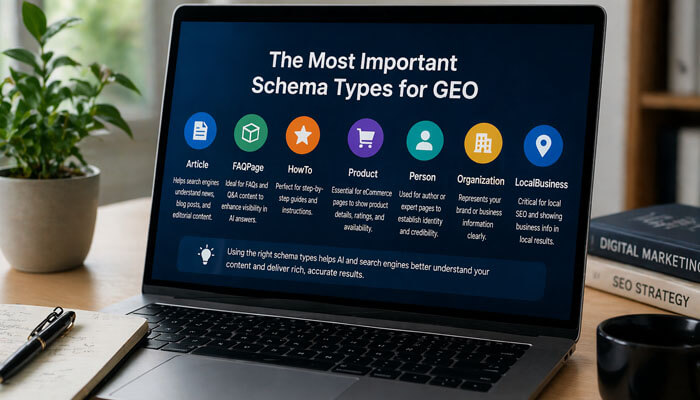
Organization / Brand schema defines your company’s identity — its name, domain, founding date, description, and official social profiles. This is the foundation. AI systems validate your organization’s existence and authority through this schema before they consider citing your content.
Article schema signals to AI that a page is a piece of editorial content with an author, publication date, and topic. It enables AI systems to properly attribute the content and assess its freshness.
FAQPage schema is particularly powerful for GEO. It structures question-and-answer pairs in a machine-readable format that AI engines can extract directly. If a user asks a question that matches your FAQ, structured FAQ schema gives your answer a direct pathway into the AI’s response.
HowTo schema maps step-by-step instructions into a format AI systems can extract and cite for procedural queries. It is particularly valuable for tutorial and process-oriented content.
Person schema on author bio pages establishes the credentials of your content creators. When AI can verify an author’s expertise through structured data, it weights that author’s content more heavily.
Product and Review schema enables AI to generate comparison-style answers for commercial queries.
Implementation Best Practices
Use JSON-LD format — it is the recommended standard and most widely supported by all major AI and search systems. Place it in the <head> of your pages or as a separate script block.
Keep your markup aligned with visible page content. AI systems and Google’s spam policies penalize misleading schema — markup that describes content not actually present on the page.
Validate your implementation using Google’s Rich Results Test and Schema.org’s validator. Monitor for errors in Google Search Console. Treat schema as living infrastructure: review it quarterly and update it when page content changes.
The key shift in mindset is this: schema does not replace content quality. It amplifies it. A thin, poorly written page with excellent schema will not earn AI citations. A genuinely authoritative, well-written page with excellent schema will earn far more citations than the same page without it.
7. GEO for Developers: Technical Implementation
For developers, GEO is fundamentally about making your content legible to machines — which is a familiar problem framed in a new context.
Crawlability and Indexation
Audit your robots.txt file to ensure you are not inadvertently blocking AI crawlers. Key crawlers to be aware of include GPTBot (OpenAI), Google-Extended, PerplexityBot, and Applebot-Extended. You may choose to allow or disallow each independently. If you want AI citation, you need to allow these crawlers.
Ensure your most important content is server-side rendered or at minimum available in a crawlable static HTML form. JavaScript-heavy single-page applications that require client-side rendering can be invisible to crawlers that do not execute JavaScript.
Page Speed and Core Web Vitals
While AI citation does not directly reward page speed the way Google rankings do, fast pages are indexed more reliably and crawled more completely. Core Web Vitals remain a proxy for technical health. Pass them.
Semantic HTML Structure
Use semantic HTML elements correctly: <article>, <section>, <h1>–<h6>, <blockquote>, <cite>, <time>. These structural signals help AI parse document hierarchy and understand which elements are primary content versus navigation, footers, or sidebars.
llms.txt
A newer convention — analogous to robots.txt — the llms.txt file is a plain-text document placed at your root domain that gives AI systems a curated map of your most important content. It is not yet universally adopted, but implementing one costs little and provides forward-looking infrastructure as AI crawlers mature.
API and Data Accessibility
If your product exposes an API or data service, document it clearly and publicly. AI systems that recommend tools to developers rely on being able to parse what your product actually does, what inputs it accepts, and what problems it solves. Clean public documentation, clear product descriptions, and well-structured developer resources all contribute to AI visibility for technical products.
8. GEO for Marketers: Content and Brand Strategy
For marketers, GEO is primarily a content quality and brand authority problem. The technical infrastructure matters, but content decisions drive outcomes.
Prioritize Research Reports and Original Data
Research reports and comprehensive guides earn the highest AI citation rates across platforms. Original proprietary data — surveys, industry benchmarks, analysis of your own product usage data — is especially valuable because it cannot be found elsewhere. AI engines favor citing unique information over rephrasing what already exists.
If your organization can publish one original data study per quarter, that becomes a citation magnet.
Write Definitional and Reference Content
Content that defines concepts, explains processes, or establishes frameworks gets cited more often than opinion or narrative content. “What is X?” pages, glossaries, comparison guides, and authoritative how-to content are structurally well-suited to AI citation.
This is why Wikipedia remains one of the most-cited sources in AI-generated answers. Its format — definitional, structured, sourced, regularly updated — is purpose-built for machine extraction. Your content does not need to mimic Wikipedia, but the underlying principle applies.
Build a Consistent Brand Presence Across Platforms
AI models form their picture of your brand from the full landscape of web content, not just your own site. Maintain consistent, accurate brand information across:
- Your website and blog
- LinkedIn (especially for B2B brands — LinkedIn is among the most-cited domains by major LLMs)
- Industry publications and guest articles
- Podcast appearances and interview transcripts
- Press releases and news coverage
- Reddit communities relevant to your sector
Inconsistent brand naming, outdated bios, or conflicting descriptions across these platforms fragment your entity recognition and reduce citation confidence.
Think in Paragraphs, Not Pages
The fundamental shift GEO demands of content teams is moving from page-level thinking to paragraph-level thinking. An AI might cite one paragraph from your best article. That paragraph needs to stand alone, make a complete point, and attribute it to your brand.
Train your writers to ask: “If only this paragraph appeared in an AI answer, would it represent our brand accurately? Would a reader know where it came from?”
9. Measuring GEO Performance
Measuring GEO requires new metrics alongside your existing SEO dashboard. Most teams track organic traffic and keyword rankings reliably — but the metrics that reveal AI visibility are still underutilized.
Core GEO Metrics
Citation rate — how often your brand or content appears as a cited source in AI Overviews and other AI-generated responses for your target queries. Test a set of 10–20 key queries across ChatGPT, Perplexity, Gemini, and Google AI Overviews. Track changes weekly.
AI mention frequency — how often your brand name is referenced in AI responses, even without a direct citation link. This captures brand presence in AI conversations that do not surface as web traffic.
AI referral traffic — sessions, engagement metrics, and conversion rates from visitors who arrived via AI platforms. Find this in your analytics by filtering referral sources for chatgpt.com, perplexity.ai, and related domains.
Branded search volume — as AI visibility grows, downstream branded search often increases. Monitor whether your brand name queries in Google Search Console are trending upward.
Tools for GEO Measurement
Dedicated GEO platforms have emerged to address this measurement gap. Semrush has added an AI Visibility Score to its existing platform. Evertune tracks AI visibility across multiple models using direct API access combined with a user panel. Ahrefs, BrightEdge, and SE Ranking have all added AI visibility components. For early-stage monitoring, manually testing key queries across platforms is free and surprisingly informative.
Interpreting the Data
AI referral traffic is small in absolute volume today — but do not dismiss it based on size alone. Even a small AI traffic segment converting at 23 times the rate of organic traffic can represent meaningful business impact. Measure by quality, not just quantity.
10. Common GEO Mistakes to Avoid
Blocking AI crawlers while trying to protect content. Many publishers that have added AI crawler blocks in robots.txt have inadvertently removed themselves from AI citation pools. If you want AI visibility, you need to allow access to the crawlers serving it.
Writing for keywords instead of concepts. GEO rewards conceptual depth and semantic clarity. A page that stuffs “generative engine optimization” 40 times but never precisely defines the term will lose to a page that defines it once, cleanly, and then explains it thoroughly.
Ignoring author identity. Anonymous or weakly attributed content earns fewer AI citations. Identified expert authors with credentials and consistent publishing histories perform significantly better.
Treating schema as optional. Given the direct citation rate improvements documented for properly implemented structured data, skipping schema markup is leaving measurable performance on the table.
Measuring GEO with SEO metrics. Citation rate and AI mention frequency are not the same as SERP rankings and organic traffic. Applying the wrong measurement framework gives you misleading data about your actual AI visibility.
Abandoning SEO in favor of GEO. Google still sends 345 times more traffic than all AI platforms combined. The right approach integrates both strategies, not one at the expense of the other.
11. The Future of GEO
GEO is evolving rapidly, and several trends will shape how it develops over the next two to three years.
AI search will keep growing, but Google will fight back. Google’s own AI Overviews and AI Mode are the company’s response to the threat posed by ChatGPT and Perplexity. The competition between these platforms will drive continued innovation in how AI answers are generated — and in what signals determine citation eligibility.
Content scarcity dynamics will intensify. Nearly 80% of top news publishers now block at least one AI training crawler. As high-quality content behind paywalls becomes less accessible to AI systems, brands that make their content openly accessible and well-structured gain disproportionate citation share in a progressively thinner content pool.
Voice and agentic search will amplify GEO. As AI assistants move from answering questions to taking actions — booking appointments, making purchases, researching on behalf of users — brand visibility in AI responses becomes directly tied to commercial outcomes, not just awareness.
The E-E-A-T bar will rise. As more brands wake up to GEO and begin optimizing their content for AI citation, undifferentiated content will earn less. The brands that will win long-term are those that invest in genuine expertise, original research, and demonstrable authority — not those who only optimize surface signals.
GEO infrastructure will become standard. Just as sitemap.xml and robots.txt became universal web infrastructure, llms.txt, structured data, and AI-accessible content architecture will be standard expectations for any professional web presence.
12. Frequently Asked Questions
What is Generative Engine Optimization in simple terms? GEO is the practice of making your content get cited by AI tools like ChatGPT, Perplexity, and Google AI Overviews when they answer users’ questions. Instead of trying to rank higher on a search results page, you are trying to become part of the AI’s answer itself.
Is GEO replacing SEO? No. GEO complements SEO — it does not replace it. Google still delivers the vast majority of search traffic. Strong SEO signals (authority, quality content, backlinks) also support strong GEO performance. The most effective strategies integrate both.
How long does it take to see GEO results? GEO results can appear faster than traditional SEO in some cases, because AI systems update their retrieval pools more frequently than Google recrawls and reindexes pages. However, building the entity authority and content depth that drives consistent AI citations is a medium-term effort — expect meaningful results over three to six months of consistent effort.
What types of content get cited most by AI? Research reports, comprehensive guides, definitional content, FAQ pages, and original data studies consistently earn the highest AI citation rates. Content that defines concepts clearly, cites sources, and is written by identified experts performs best.
Does social media content affect GEO? Yes — indirectly. User-generated content platforms like Reddit and LinkedIn are among the most-cited sources by major LLMs. Active, credible brand presence in relevant professional communities contributes to your AI citation footprint. What others say about your brand across the web matters as much as what you publish on your own site.
What is the difference between GEO and AEO? Answer Engine Optimization (AEO) is an older term that often refers specifically to optimizing for featured snippets and voice search assistants. GEO is a broader, more current term that encompasses optimization for the full range of AI-generated responses, including large language models like ChatGPT and Perplexity. The two concepts overlap significantly.
How do I check if my brand is being cited by AI? The simplest approach: manually test 10–20 queries relevant to your brand or category across ChatGPT, Perplexity, Gemini, and Google AI Overviews. Note whether your brand appears, how it is described, and whether it is cited positively or neutrally. Purpose-built tools like Semrush’s AI Visibility Score and Evertune offer more systematic tracking.
This guide is updated regularly to reflect the latest developments in AI search. If you are building a GEO strategy for your organization and want to go deeper on any section, consider exploring the structured data implementation or content authority sections — those are where most brands have the most immediate room to improve.